Be yourself; Everyone else is already taken.
— Oscar Wilde.
This is the first post on my new blog. I’m just getting this new blog going, so stay tuned for more. Subscribe below to get notified when I post new updates.
Be yourself; Everyone else is already taken.
— Oscar Wilde.
This is the first post on my new blog. I’m just getting this new blog going, so stay tuned for more. Subscribe below to get notified when I post new updates.
Hello Everyone,
My professional learning community is called ‘Teachers Transforming Nursing Education’. This group contends that nursing education needs to evolve to emphasize the development of clinical reasoning skills. Much of the founder’s inspiration was from Patricia’s Benner’s 2009 book, Educating Nurses: A Call for Radical Transformation.
For this assignment I created a PowerPoint presentation that outlined my current understanding of the philosophical foundations, curricular conceptions, and curricular designs as they relate to the clinical reasoning skills for which this professional learning community espouses. I tied in quotes, ideas and descriptions from Benner to support my work.
Here is a screen shot of my post to this page:
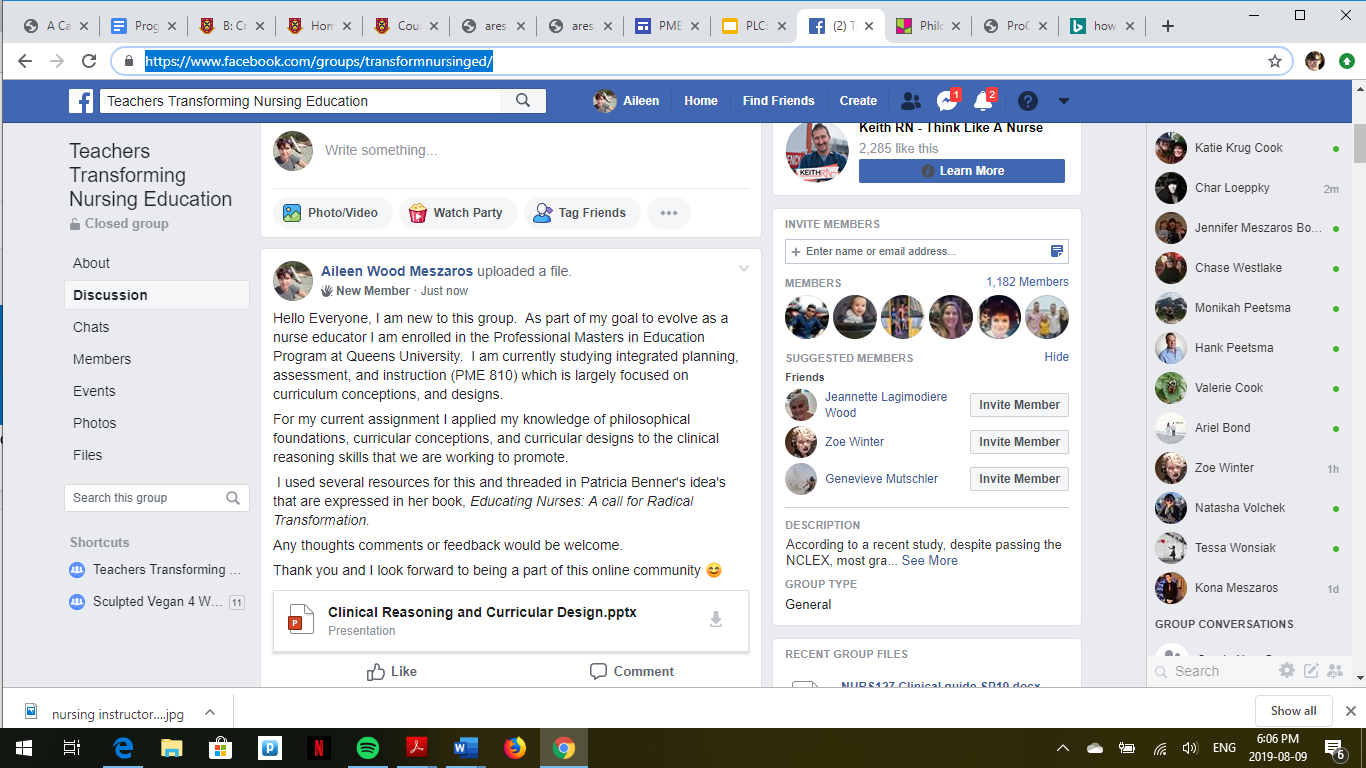
Here is a link to the Facebook page:
https://www.facebook.com/groups/transformnursinged/
Here is a copy of the presentation I posted:
https://1drv.ms/p/s!AqMezWWD1VKnj3RqW0_23PMLph_P
The biggest challenge that I felt in creating this was the nervousness of putting my work out publicly. I found myself feeling concerned over how it would be received and for this reason it took me a long time to create my presentation.
I am waiting for feedback or comments at which time I will continue this journal entry.
It is now Saturday and the reflection on the experience is due. I have checked in on my post several times and I have not received any comments.
I am concerned because one of the goals of this assignment was to stimulate dialogue with the professional community. I spent so much time putting together a comprehensive presentation of my current understandings of course content as they relate to the ideologies (clinical reasoning skills) of the the group, and I received a few likes but, no comments.
I have a few theories for why this may have occurred. I have noted that most posts on this group are short. My post contains a lot of information and the presentation itself is quite packed. It may be more information than people want to take in? Another theory is the time frame. I posted this yesterday and there has not been a enough exposure time? Another thought is the nature of Facebook groups, if a post is not generating much attention, it will get buried under every subsequent post. Maybe I should have just post a few short questions to see if I could generate discussion? But I did not think that would meet the assignment criteria.
I am curious to read my classmates experience with this. I wonder if others had the same difficulty, or if anyone has feedback that might help me to understand what I could have done differently.
Regardless, I am still learning from this group. Many individuals are posting resources, some of which I have downloaded. Many are posting general questions and requesting help with concepts. Although I have found lately that my workload between the 2 courses has been heavy and leaving little time to engage, I see this as an active community that shares my perspective on nursing education and I know that I will continue to have learning opportunities within it.
Professional Learning Communities REFLECTION
I have been a nurse educator in the Bachelor of Science in nursing degree program for the past 7 years. During this time, I have witnessed great conflict in the ideologies and thereby curricular conceptions of my colleagues. I was curious what philosophies or curricular conceptions might I find threaded through the various online nurse educator professional communities? I decided to check-out the Canadian Association of Schools of Nurses as a starting point. They had a list of specialized nurse educator ‘interest groups’; however, they wanted $50 for a registration fee… so I moved on. I went to Facebook and found that there were many nurse educator professional groups to choose from. I wanted to find one that demonstrated a high number of users, was currently active, was a ‘closed’ group, and that I felt would be of interest and helpful in my journey to evolve as an educator.
Professional Community:
The online professional community that I settled on is “Teachers Transforming Nursing Education’ https://www.facebook.com/groups/transformnursinged/. I had no difficulty joining. There were three questions to answer, then a short waiting period (24h) to see if would be accepted, and then I was accepted and received a welcome notice from the facilitator of the group.
I will copy the summary from the ‘About This Group’ page:
According to a recent study, despite passing the NCLEX, most graduate nurses (77%) are unable to think like a nurse. This is unacceptable and why the status quo of infobesity and passive learning in the classroom (spoonfeeding) needs to go!
Transforming nursing education is a process like the metamorphosis of a butterfly and requires teachers who recognize the need to change.
How do you transform nursing education?
One educator at a time!
If that’s you, then you have found a safe place to be supported, encouraged and learn from other educators who have stepped out of their comfort zone and were able to better prepare students for real-world practice as a result! This is a community to share, grow, and learn from each other!
This group is lead and facilitated by Keith Rischer (https://www.keithrn.com) who started his journey as an experienced nurse and new educator to transform nursing education after reading Educating Nurses: A Call for Radical Transformation in 2012 (https://www.facebook.com/groups/transformnursinged/about/)
The overarching message is that as nurse educators our responsibility is to teach clinical reasoning skills to prepare students for the realities of the profession. The group leader and facilitator has created unique clinical reasoning case studies, tools, and the student textbook ‘THINK Like a Nurse’ (https://www.keithrn.com/strengthen-student-transition/) and educator text ‘TEACH Students to THINK Like a Nurse’ (https://www.keithrn.com/teach/) (these are not free). The general posts within the group are to share ideas, ask questions, and post resources that all appear to be supportive of the premise that we need to assist our students with real-life clinical reasoning skills.
Analysis and relationship to course concepts:
As you can see from the opening statement, “despite passing the NCLEX, most graduate nurses (77%) are unable to think like a nurse.” The philosophy of the professional group is one that does not support teaching to the test (or subject-based design) as being sufficient in preparing nursing students. This got my attention.
What really attracted me to this group was idea of transforming nursing education to prepare students for the realities of the profession. I believe there is great value in finding ways to teach students to ‘think’ like a nurse, and the book, ‘Educating Nurses: A Call for Radical Transformation’ by Patricia Benner (which inspired the founder of the group) asserts this as a necessary change to meet the evolving health care systems requirements.
The philosophical base from which this type of idea arises is reconstructivism and pragmaticism. The instructional objective of this educational philosophy is based on the needs of society. In this case it is the needs of the health care system, and the thereby the need to adequately prepare nursing students to function within it, and over time, to improve it.
The curricular conceptions that most directly enact this philosophy are social reconstructive relevance, and the development of cognitive processes. Social reconstructive relevance is described by Eisner and Vallance (1974) as having an emphasis on the role of education and curriculum within the larger social context. What are the societal needs? How do we best prepare student to be active and responsible members within that society? How do I, as a nurse educator, best prepare my students to meet the needs of the health care system and to be active and responsible members within it? The development of cognitive process is primarily concerned with the refinement of intellectual operations (Eisner & Vallance). This professional learning community is highly focussed on how to teach the students clinical reasoning skills through the contextual case-study style learning activities. The emphasis is on the development of specific cognitive skill development of clinical reasoning that can then be applied to real-life situations.
How does this play-out in planning, instruction and assessment? I will be curious to see the specific recommendations that I uncover overtime interacting with this group. For now, I will speak from my experience and knowledge of these curricular conceptions (from our course readings)for how this can be realized.
I believe that the best way to enact most of these conceptions is in a learner and problem-centered/Society focused design.
Planning will involve understanding the current needs of society and health care, emerging technologies, advancements in diagnostics, pharmacology, and the role and responsibility of the nurse within it. Courses will have to be up to date with the emergence of new health care trends and expectations and include the intention of cognitive development through the planning of appropriate learning activities. Planning to meet the individual learning needs of the students should be incorporated. Back mapping, planning activities based on the desired outcomes would be appropriate.
Instruction will involve repetitive solving of contextual case studies to develop the desired clinical reasonings skills. These case studies need to be based on, utilize, and integrate the most current information available in the health sciences. Real life application occurs and is facilitated by the clinical instructor in the care setting (hospital/residential/long-term care). Formative assessment to inform ongoing evolving lesson plans would be appropriate to ensure instruction is meeting the individual needs of each student.
Assessment should challenge students to demonstrate the clinical reasoning skills for which the instruction was based (back-mapping). For learner centered design, specific meaningful feedback will be essential to the individualized growth of each student. According to Hayes, (2003) problem centered and society focussed designs will assess the students “capacity to exercise judgement and responsibility in matters of morality, ethics and social justice (p.230).
I am excited to see what learning I can gain from participating in this community. I must admit that I was attracted to it as it is in line with my philosophies and pedagogy. I teach applied nursing science and use a multitude of application type activities including case studies and simulation. I believe that I can be an active member and contributor to this group. I have suggestions for many of the discussion questions, and I have already downloaded a learning activity that was posted. I believe my involvement will benefit my practice as a nurse educator, and I will have the opportunity to assist others.
References:
Hayes, D. (2003) Making learning an effect of schooling: aligning curriculum, assessment and pedagogy, Discourse: studies in the cultural politics of education, 24(2), 225-245McNeil, J. D. (2009). Contemporary curriculum in thought and action (7th ed.). Hoboken, NJ: John Wiley. Pages 1, 3-14, 27-39, 52-60, 71-74.
Ornstein, A. C., & Hunkins, F. P. (2013). Curriculum: Foundations, principles, and issues (6th ed.). Boston, MA: Pearson. Read Chapter 6, pp. 149-173.
Shepard, L. A. (2000). The role of assessment in a learning culture. Educational Researcher, 29(7), 4-14. doi:10.3102/0013189X029007004
Sowell, E. J. (2005). Curriculum: An integrative introduction (3rd ed., pp. 52-54, 55-61, 81-85,103-106). Upper Saddle River, NJ: Pearson.
Planning, Instruction, and Assessment and Curricular Designs
Here is my updated Padlet: click on the square with an arrow icon in the top right corner for full screen and scroll down to ‘Planning, Instruction, and Assessment Considerations for Curricular Designs’ to see my recent work.


Queens University PME 810
Module 1
Conceptions of Curriculum
In this entry I will consider, from my personal perspective, why I believe some conceptions of curriculum continue to be used over time or are mainstream approaches, while others are not. Additionally, I will explain my interpretation of conceptions of curriculum and how I can use them as tools or frameworks to analyze planning, instruction, and assessment within my specific practice.
When I consider what I have learned about conceptions of curriculum from our course readings I believe that shifting priorities and paradigm shifts in values have largely influenced why some conceptions of curriculum become widely used and others are less. This conclusion is based on the discussions in many of the articles which referred to time frames when one orientation was in greater use related to the thinking or values of that period. For example, Orstein and Hunkins (2013) referred to the academic approach being prevalent in the 1930’s-1950’s and became less popular when interest in curriculum shifted towards more qualitative methods; Eisner and Vallance (1974) refer to social reconstructive theory as being “hardly new” (p.10) and running through much of history in conjunction with work towards educational reform and the push for social change; and McNeil (2009) discuss how the outcome-based aspect of systemic curricular orientation became popular in the 1990’s related to the idea that “curriculum should center on essential far-reaching outcomes that all students would meet and demonstrate…” (p.56). In the articles, most of the descriptions of various curricular orientations included an explanation for the thinking (values and priorities) of the time frame that influenced its popularity, for this reason, I have determined that what makes a curricular orientation mainstream is the current ideologies, many of which came in and out of favor over time.
What is my interpretation of conceptions of curriculum? My answer to this relates to what has happened through history with the relationship between current ideologies and prevalent curricular orientations. I love the definition of an ideology provided by Shiro (2013).
“An ideology is a collection of ideas, a comprehensive vision, a way of looking at things, or a worldview that embodies the way a person or a group of people believes the world should organized and function. It is “a certain ethical set of ideals, principles, doctrines, myths or symbols of a social movement, institution, class, or large group that explains how society should work, and offer some political and cultural blueprint for a certain social order (Wikipedia, n.d.,’ 1).” (p 8-9).
It is my understanding that a conception of curriculum is how you will orientate your educational plan based on current ideologies. This can be on a national, provincial, intuitional, or individual level. What values are you promoting through your educational approach? Is self-actualization and deep integration of knowledge essential? Do you need to be able to measure outcomes and results against standardized benchmarks? Are we concerned with social reform, the state of the environment, the injustices of society? Based on the identified ideologies, all aspects of the curriculum, from planning, to instruction, to evaluation can be determined. The ideologies can be used as a blueprint to construct the conception of curriculum.
However, I would be remiss to not mention that it is evident in my own work as a college teacher that more than one curricular orientation can be employed simultaneously within one educational setting or program. This was also discussed by Nadya Al Mousa (2013) Master’s Thesis where multiple orientations of curriculum where identified in two Canadian Colleges Interior Design Programs.
Al Mousna (2013) analyzed the curricular orientations in two different Interior Design Programs. When I was considering how conceptions of curriculum can be used to as a framework or tool to analyze the planning, instruction, and evaluation in the context of my individual practice I reviewed her process. The steps that she described began by reviewing the program information, course descriptions, syllabi and various course materials. She chose specific conceptions of curriculum to analyze these against, then categorized each course into groupings based on the identified conception of curriculum and looked at all stages of the program (years 1-4) in consideration of her research questions.
I believe I could follow a similar process to analyze the planning, instruction, and evaluation of the nursing program at Camosun College (where I teach). Like the interior design programs, our nursing program is a 4-year degree program. In the first year foundational concepts are introduced; the history of nursing, anatomy and physiology, and foundational nursing skills and assessment. These courses, the descriptions, syllabi, and learning activities could be further analyzed to see which curricular orientation they best fit with. From my current understanding of the first year nursing courses, and of curriculum orientation, I would suggest that they best fit with academic rationalism also called the cumulative tradition of organized knowledge. This orientation is generally described as providing the tools for learners to participate in Western culture and to understand the structure of knowledge by studying the established disciples (Eisner & Vallance, 1974; McNeil, 2009; Sowell, 2005). In these courses a foundation is set for further study, the students learn about the Latin and ancient Greek roots of terminology in anatomy and physiology, they learn about the history of the nursing profession and Florence Nightingale, and they learn basic skills of assessment. This fits with the description for academic rationalism curricular orientation.
I recognize that a variety of different conceptions of curriculum are threaded throughout the various courses of the nursing program. For example, self-actualization curriculum is described as being value saturated, where the personal purpose of each learner is identified and integrated; the learner is expected to get to know themselves and experience a form of transcendence or increased inner awareness (Eisner & Vallance, 1974; Sowell, 2005). In each of our nursing practice courses the students write personal critical reflections on their experiences, part of the goal for these reflections is increased personal awareness. The individual values and personal growth of each student are identified and explored in the context of their nursing practice. In this way, they fit with self-actualization.
In the applied nursing science course that I personally teach I recognize that the development of cognitive processes conception of curriculum is prevalent. In this conception the focus is on the development of cognitive skills that can be transferred to a wide variety of circumstances (Eisner & Vallance, 1974). In this course we do repetitive problem solving of complex medical case studies, the cognitive skills the students are expected to develop are analysis and synthesis of data, critical thinking, and application of knowledge to determine and prioritize appropriate nursing skills. The larger goal is that these cognitive skills can be transferred to patient care.
Social reconstructive curriculum prioritizes the relationship between curriculum and political, economic and social progress in society (Eisner & Vallance, 1974; McNeil, 2009; Orstein & Hunkins, 2013). In many of our nursing courses we promote social change and address injustices, for example, we teach about the history of colonization in Canada, the atrocities that occurred, the lasting impact this has had on the indigenous people, current systemic racism, health disparities, and how we can work on reconciliation and promote improved relationships on a larger scale.
Humanistic curriculum is also present in our program; this conception is described as assisting students to fulfill their personal visions for themselves, the learning has personal relevance, includes feelings, and involves self-efficacy (McNeil, 2009; Orstein & Hunkins, 2013). Several of our nursing courses explore personal values, learning styles, and communication to increase skills in human relations, we refer to these courses generally as relational practice courses.
With each of these courses, the use of conceptions of curriculum for analysis could be used at all stages of course development (planning, instruction, evaluation). For example, in planning out the course, what are the learning outcomes? What curricular conception are they in line with? How do we intend to organize the content in a sequential and digestible manner? In course instruction, how do we intend to relay this material? What are the priorities? Are we looking to promote social change? Or are we largely concerned with test scores? Do we need to confirm that particular cognitive abilities have been acquired? Finally, in evaluation, can we assess the personal evolution of the individual learner? Has some form of self-actualization occurred? How are they performing on standardized tests? Are they impacting the community with some form of social change?
In this blog entry I have explored what I have learned about conceptions of curriculum. I have considered why I believe some conceptions are popular (or mainstream) at various times in relation to the current most prominent ideologies. I have also discussed how conceptions of curriculum can be used as a framework to analyze the planning, instruction and evaluation of the nursing program within which I teach. I used Nadya Al Mousa (2013) Master’s Thesis to discuss the steps in this process.
References
Al Mousa, N. (2013). An examination of cad use in two interior design programs from the perspectives of curriculum and instructors, pp. 21-37, 138-147 (Master’s Thesis).
Eisner, E., & Vallance, E. (Eds.). (1974). Five conceptions of the curriculum: Their roots and implications for curriculum planning. In E. Eisner & E. Vallance (Eds.), Conflicting conceptions of curriculum (pp. 1-18). Berkeley, CA: McCutchan Publishing.
McNeil, J. D. (2009). Contemporary curriculum in thought and action (7th ed.). Hoboken, NJ: John Wiley. Pages 1, 3-14, 27-39, 52-60, 71-74.
Ornstein, A. C., & Hunkins, F. P. (2013). Curriculum: Foundations, principles, and issues (6th ed.). Boston, MA: Pearson. Read part of Chapter 1, pp. 1-8.
Schiro, M. S. (2013). Introduction to the curriculum ideologies. In M. S. Schiro, Curriculum theory: Conflicting visions and enduring concerns (2nd ed., pp. 1-13). Thousand Oaks, CA: Sage.
Sowell, E. J. (2005). Curriculum: An integrative introduction (3rd ed., pp. 37-51). Upper Saddle River, NJ: Pearson.
This is an example post, originally published as part of Blogging University. Enroll in one of our ten programs, and start your blog right.
You’re going to publish a post today. Don’t worry about how your blog looks. Don’t worry if you haven’t given it a name yet, or you’re feeling overwhelmed. Just click the “New Post” button, and tell us why you’re here.
Why do this?
The post can be short or long, a personal intro to your life or a bloggy mission statement, a manifesto for the future or a simple outline of your the types of things you hope to publish.
To help you get started, here are a few questions:
You’re not locked into any of this; one of the wonderful things about blogs is how they constantly evolve as we learn, grow, and interact with one another — but it’s good to know where and why you started, and articulating your goals may just give you a few other post ideas.
Can’t think how to get started? Just write the first thing that pops into your head. Anne Lamott, author of a book on writing we love, says that you need to give yourself permission to write a “crappy first draft”. Anne makes a great point — just start writing, and worry about editing it later.
When you’re ready to publish, give your post three to five tags that describe your blog’s focus — writing, photography, fiction, parenting, food, cars, movies, sports, whatever. These tags will help others who care about your topics find you in the Reader. Make sure one of the tags is “zerotohero,” so other new bloggers can find you, too.
Have a WordPress.com account? Log in now.

